
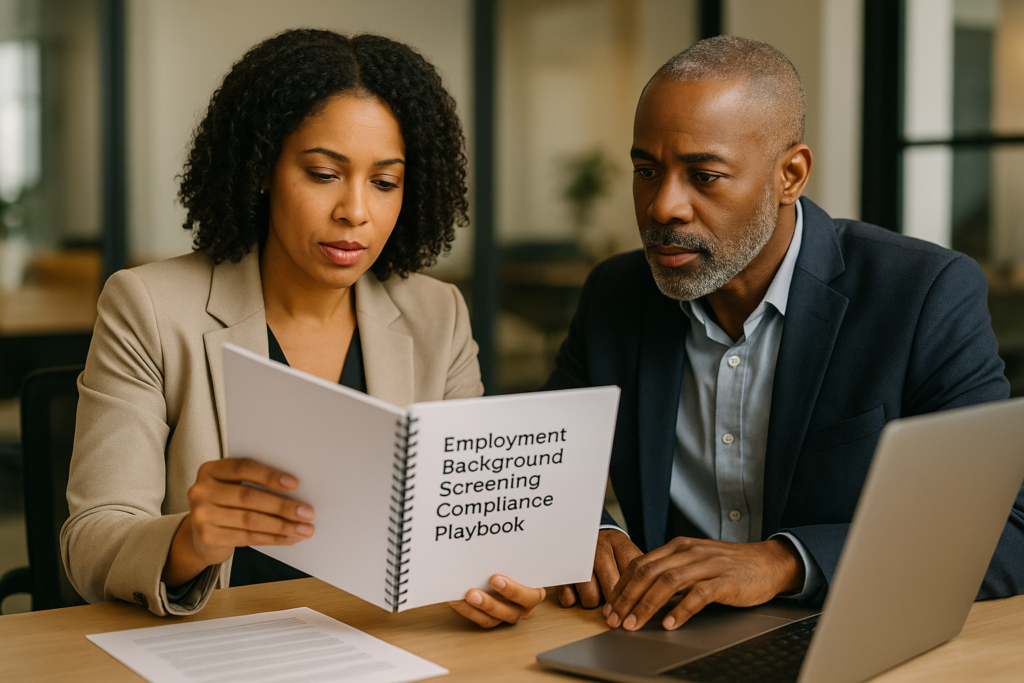
Employment Background Screening Compliance Playbook
=
Employment background screening: a practical compliance playbook for HR leaders
Estimated reading time: 8 minutes
Key takeaways
- FCRA compliance is mandatory: use standalone disclosure and authorization forms and follow the two-step adverse-action process.
- Criminal-history rules are layered: obey EEOC guidance, Ban-the-Box timing, and state/local variations; tailor decisions to job relevance.
- Operationalize screening: written policies, centralized ordering, vendor oversight, and automated recordkeeping reduce risk and speed hiring.
- Document and train: keep auditable records for at least two years and provide annual training for hiring teams.
Table of contents
FCRA essentials employers must get right
The Fair Credit Reporting Act (FCRA) governs most pre-employment background checks that come from consumer reporting agencies (CRAs). FCRA violations have led to multi‑million dollar settlements; compliance is non‑negotiable.
Key FCRA requirements
- Standalone disclosure and written consent: Provide a clear, standalone written disclosure that you will obtain a consumer report, and obtain the applicant’s written authorization before ordering the report. Don’t bury consent language in an application or combine it with other agreements.
- Adverse action process: If information in a background report leads to a refusal to hire (or a materially different employment decision), follow the two‑step adverse action procedure:
- Issue a pre‑adverse action notice that includes a copy of the report and the CRA’s summary of consumer rights, and give the candidate a reasonable opportunity to dispute inaccuracies.
- If you still decide not to hire after any dispute, send a final adverse action notice that cites the CRA and provides necessary disclosures.
- Accuracy and reasonable procedures: You and the CRA share responsibility to ensure report accuracy. FCRA requires reasonable steps to verify data before making adverse hiring decisions.
- CRA certification: When ordering reports, certify to the CRA that you provided the required disclosure, obtained authorization, and will comply with adverse action rules and anti‑discrimination laws.
Missing any step can trigger regulatory enforcement, class actions, or costly settlements. Make these processes institutional and auditable.
EEOC, Ban-the-Box, and state/local rules: layered compliance risks
Beyond FCRA, criminal‑history screening raises four additional considerations: anti‑discrimination law, Ban‑the‑Box rules, state variations, and job‑relatedness.
- EEOC and disparate impact: The Equal Employment Opportunity Commission (EEOC) cautions that blanket exclusions based on arrest records or broad criminal history policies can have a disparate impact on protected groups. To avoid liability, criminal‑background criteria must be job‑related and consistent with business necessity. That means tailoring exclusions to the role and considering the nature of the offense, its relation to the job, and the time elapsed.
- Ban‑the‑Box and fair‑chance laws: Many states, counties, and cities limit when employers can ask about criminal history — commonly requiring employers to wait until after a conditional offer. Some jurisdictions even require removal of the question from initial applications. These laws vary widely; a single nationwide hiring workflow risks noncompliance.
- State-specific adverse action requirements: Some states impose additional notice timing, content, or documentation obligations beyond FCRA’s baseline. Make sure your adverse action templates reflect state nuances.
- Records and retention: Retain consents, disclosures, and adverse action records for the period required by federal or state law (a common best practice is at least two years) to defend decisions in audits or litigation.
For criminal history, EEOC guidance suggests a targeted analysis: a theft conviction may be directly relevant for a cashier but not for a software developer. Use job analyses to justify decisions.
Operational best practices for compliant employment background screening
Turn legal requirements into reliable operational steps. The following practices reduce risk, speed hiring, and create consistent candidate experiences.
Foundational policies and documentation
- Create a written screening policy that defines what checks you run for each role (criminal history, employment, education, license verification, motor vehicle records, credit reports where lawful), how you’ll evaluate findings, and who is authorized to order or act on reports.
- Use standalone FCRA disclosure and authorization forms separate from applications and other notices.
- Maintain clear templates for pre‑adverse and final adverse action notices that can be customized by state.
Process design and training
- Train hiring managers and recruiters annually on FCRA, EEOC considerations, Ban‑the‑Box rules, and your internal screening policy. Include practical examples of job‑related justification.
- Centralize ordering and review of reports when possible to reduce inconsistent or unauthorized use of background data.
- Implement role‑specific decision matrices that document which offenses are relevant and under what circumstances. Avoid blanket exclusions.
Vendor management
- Use a reputable CRA or background‑screening partner that understands FCRA compliance and state/local regulations. Require vendor certifications of compliance and documented dispute‑resolution procedures.
- Audit your vendor regularly for accuracy rates, turnaround time, and quality of source verification. Ask for examples of how disputes were handled and corrected.
Candidate communication and fairness
- Use clear, timely communication. If you intend to take adverse action, give candidates a copy of the report and an opportunity to dispute inaccurate information before finalizing your decision.
- Consider giving candidates a chance to provide context for criminal records (rehabilitation, expungement, circumstances). Document how you weighed that input.
Technology and recordkeeping
- Automate record retention for disclosures, authorizations, and adverse-action notices. Keep records at least two years or per state requirement.
- Build audit trails showing who accessed reports and what decision steps were taken.
Checklist: immediate fixes HR teams can implement this quarter
- Replace any combined application/consent language with a standalone FCRA disclosure and authorization.
- Audit job descriptions and map which background checks apply to each role.
- Update application forms to comply with local Ban‑the‑Box rules (delay criminal history questions where required).
- Standardize pre‑adverse and final adverse notice templates, including state‑specific language.
- Schedule an annual training for hiring teams on FCRA, EEOC, and your policies.
- Establish a vendor SLA that includes accuracy measures and dispute handling.
Common compliance pitfalls — and how to avoid them
Avoid these recurring mistakes that lead to litigation or regulatory scrutiny.
- Pitfall: Burying consent in the application
Fix: Use a standalone disclosure and separate signed authorization. Make the language plain and conspicuous. - Pitfall: Skipping the pre‑adverse step
Fix: Build pre‑adverse notices into your workflow and set automated reminders to allow candidates time to dispute. - Pitfall: Using arrests, not convictions, as disqualifiers
Fix: Adopt a convictions‑focused approach unless arrests are specifically job‑related and you have a documented business necessity. - Pitfall: One‑size‑fits‑all criminal policies
Fix: Use job analyses and decision matrices to justify relevance and duration of exclusions. - Pitfall: Ignoring local Ban‑the‑Box rules
Fix: Maintain a jurisdictional map of timing and disclosure requirements; update hiring portals accordingly. - Pitfall: Poor vendor oversight
Fix: Contractually require CRAs to certify compliance, provide audit access, and document dispute outcomes.
Practical takeaways for employers
- Treat employment background screening as a cross‑functional compliance program, not an administrative afterthought.
- Use separate FCRA disclosure/authorization forms and document every step of the adverse‑action process.
- Tailor criminal‑history screening to specific job duties and keep a defensible record of job‑relatedness and business necessity.
- Delay criminal inquiries where Ban‑the‑Box laws require a post‑conditional‑offer timing.
- Train hiring personnel annually and centralize ordering and decisioning when possible.
- Retain screening records for at least two years and audit vendors regularly.
- When in doubt, consult counsel about state or local variations before changing hiring workflows.
How a screening partner can reduce your compliance burden
A knowledgeable background‑screening partner can operationalize legal requirements: providing compliant disclosure and authorization forms, managing pre‑adverse and adverse notices, verifying records to improve accuracy, and handling candidate disputes. Outsourcing these tasks reduces administrative risk — particularly during high‑volume hiring — while enabling your HR team to focus on candidate engagement and onboarding.
Employment background screening is a compliance and people issue. Done well, it protects the workplace and supports fair hiring practices without slowing hiring cycles.
If you’d like help aligning your screening program with FCRA, EEOC, and local laws, Rapid Hire Solutions can review your forms, policies, and workflows and recommend practical next steps to reduce legal exposure and improve turnaround times. Contact us to learn how we can support your compliance and hiring goals.
FAQ
What are the core FCRA steps employers must follow before taking adverse action?
Answer: Employers must provide a standalone disclosure and obtain written authorization before ordering a consumer report. If the report may lead to an adverse decision, issue a pre‑adverse action notice with a copy of the report and the CRA’s summary of rights, allow the candidate time to dispute inaccuracies, and if the decision stands send a final adverse action notice citing the CRA and required disclosures.
How do Ban‑the‑Box laws affect hiring workflows?
Answer: Ban‑the‑Box and fair‑chance laws commonly require employers to delay asking about criminal history until after a conditional offer. Some jurisdictions require removal of the criminal-history question from initial applications. These rules vary by jurisdiction, so maintain a map of local requirements and adapt application forms accordingly.
Should employers base disqualifications on arrests or convictions?
Answer: As a best practice, focus on convictions unless an arrest is specifically job‑related and can be justified with documented business necessity. Using arrests broadly increases risk of disparate impact claims.
How long should screening records be retained?
Answer: Retain consents, disclosures, and adverse action records per federal or state requirements. A common best practice is at least two years to defend decisions in audits or litigation; however, verify state-specific retention rules.
What operational steps reduce screening-related legal risk?
Answer: Key steps include: documented screening policies, standalone FCRA forms, centralized ordering, role‑specific decision matrices, annual training, vendor SLAs and audits, and automated recordkeeping with clear audit trails.
When should I consult legal counsel about my screening program?
Answer: Consult counsel before changing workflows that may be affected by state or local laws (e.g., Ban‑the‑Box timing, state adverse action nuances) or when you need to document business necessity for job‑related criminal‑history exclusions.