2026 State Guide to Marijuana Pre-Employment Testing for Employers
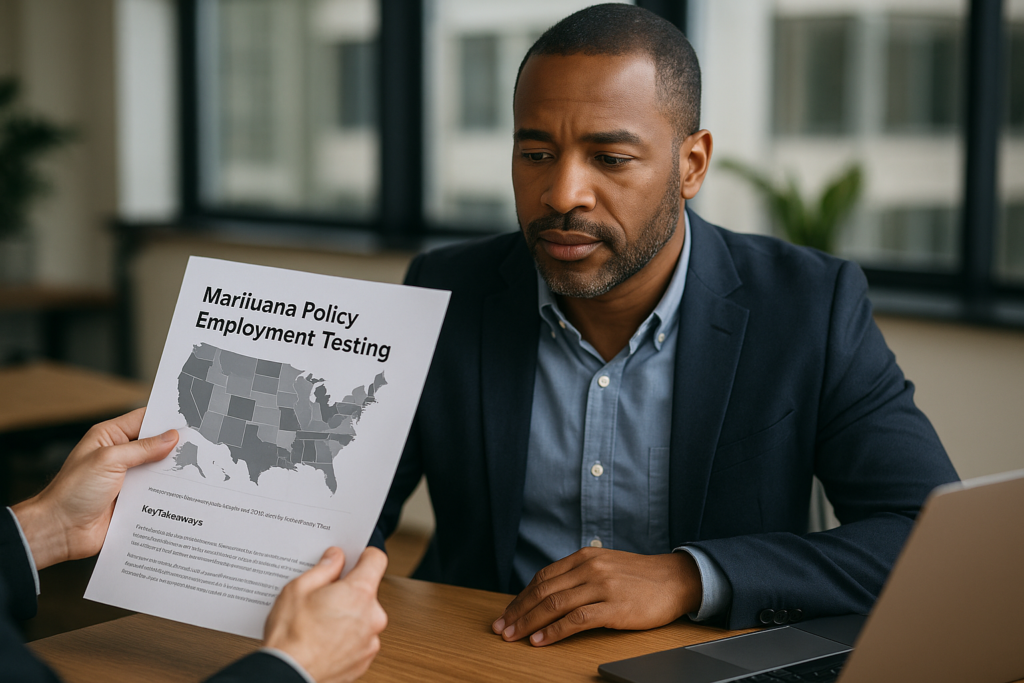
Marijuana and Pre-Employment Drug Testing: A 2026 State-by-State Reality Check
Estimated reading time: 6 minutes
Key takeaways
- State and local laws vary widely: employers must adopt jurisdiction-specific approaches rather than a single national policy.
- Test choice matters: urine detects past exposure; oral fluid and select blood tests detect more recent use—none measure impairment like a breathalyzer.
- Safety-sensitive roles are special: federal rules (DOT and other programs) and documented essential functions can limit employer flexibility.
- Medical cannabis complicates hiring: engage the interactive process, document decisions, and consult counsel where statutes are unsettled.
Marijuana and pre-employment drug testing: what employers actually face in 2026
Hiring teams are still trying to reconcile two competing priorities: attract and retain talent in a tight labor market, and manage workplace safety and regulatory risk. Add the ongoing state-by-state scramble over cannabis law, and the question “Can we test applicants for marijuana?” has become one of the most consequential compliance and talent decisions HR leaders make. This article lays out the 2026 reality—what’s changed, where uncertainty remains, and practical actions you can take now to keep hiring lawful and defensible.
Key realities to acknowledge up front
- State and local laws vary widely. Some jurisdictions now restrict or ban pre-employment testing for THC; others protect medical cannabis users; many still allow unconditional testing and adverse employment actions.
- Federal rules continue to supersede in specific areas. For instance, Department of Transportation (DOT) and other federal safety programs still prohibit marijuana use for safety-sensitive, federally regulated employees.
- A positive lab result usually indicates past exposure, not current impairment. Traditional urine tests detect non-psychoactive metabolites that can persist for days or weeks—poor indicators of on-the-job impairment.
- Testing technology and employer practices are shifting. Recent-use testing (saliva/oral fluid, blood in limited cases) and impairment-based assessments are gaining traction where legal and practical.
- Litigation and regulatory scrutiny are increasing. Employers face claims under state employment laws, disability laws tied to medical cannabis use, and local ordinance violations if policies aren’t aligned with jurisdictional requirements.
Given this complexity, a single “one-size-fits-all” policy is risky. Employers need a state-, role-, and risk-specific approach that’s defensible and operationally realistic.
How states have diverged — practical categories employers should use
Rather than a state-by-state checklist that will age quickly, classify jurisdictions into practical categories that guide policy decisions:
- Jurisdictions that limit or prohibit pre-employment THC testing
These laws typically bar employers from conditioning hiring on a positive THC test or from refusing to hire for off-duty cannabis use. They may still allow drug testing for safety-sensitive positions.
- Jurisdictions that protect medical cannabis patients
Some states require employers to engage in an accommodation process for medical marijuana use or prohibit adverse action for lawful off-duty medical cannabis use.
- Jurisdictions that protect off-duty recreational use
A growing number of places prohibit employment discrimination based on off-duty, off-premises cannabis use, even for recreational consumers.
- Jurisdictions with no special protections
Employers retain broad discretion to test and discipline applicants and employees, subject to general employment and disability laws.
Two practical takeaways:
- Don’t guess your classification. Check current state law and any local ordinances for each location where you recruit, hire, or maintain employees.
- Treat DOT and other federal regulatory coverage separately—federal rules apply regardless of state-level permissiveness.
Testing limitations and choosing the right approach
Understand what your test tells you and whether that information is job-related:
- Urine tests detect THC metabolites and often reflect use days to weeks earlier. They’re still common but have limited value for assessing recent use or impairment.
- Oral fluid (saliva) tests and certain blood tests can detect more recent cannabis use and are increasingly used where current-use detection matters.
- No lab test reliably measures “impairment.” Observational impairment assessments and trained supervisor observations remain essential for safety decisions.
When deciding on a testing strategy, align the method with the risk you are trying to manage: preventing impairment in safety-sensitive roles requires different tools than screening for any cannabis exposure in a non-safety setting.
“No lab test reliably measures ‘impairment’ the way breath alcohol levels indicate intoxication.”
Medical cannabis and accommodation requests: a practical framework
Medical cannabis raises thorny accommodation issues. Courts and state agencies have reached different conclusions about whether employers must accommodate medical cannabis users. Use this framework to reduce legal risk:
- Identify essential functions and safety-sensitive tasks. If an employee’s role requires unimpaired performance for safety, document that requirement carefully in job descriptions.
- Engage the interactive process. If a qualified applicant or employee requests accommodation for a documented medical cannabis prescription, evaluate whether a reasonable accommodation exists (e.g., modified duties, schedule changes, remote work).
- Prioritize safety and federal compliance. For DOT-covered roles and other federally regulated positions, federal law typically controls and medical cannabis will not be permissible.
- Document consistently. Capture medical information, accommodation requests, the interactive process, and the rationale for any denial tied to job-related safety concerns.
Consult employment counsel for complex accommodation situations—state laws differ on whether medical marijuana is considered a protected disability or merely a protected off-duty activity.
Best practices for a defensible pre-employment drug testing policy
Implement testing policies that are lawful, consistent, and aligned with operational needs. Core elements to include:
- Scope and roles: Define which positions are subject to testing (e.g., safety-sensitive, supervisory, client-facing).
- Timing: Specify when tests are administered—post-offer conditional testing, reasonable-suspicion testing, post-accident, and return-to-duty.
- Test types and cutoffs: Identify accepted testing methods and note when more recent-use tests (oral fluid) are used.
- Medical cannabis and accommodation language: Describe how the company will handle requests and whether medical cannabis will disqualify a candidate for specific roles.
- Confidentiality and privacy: Commit to secure handling of test results and limited disclosure on a need-to-know basis.
- Consistency and non-discrimination: Apply rules uniformly to avoid claims of disparate treatment.
- Adverse-action protocol: Document a compliant process for disqualification, appeals, and reporting when adverse action is taken.
Train hiring managers and HR on consistent application. Inconsistent enforcement is a common source of litigation.
Integrating background screening and drug testing workflows
Pre-employment screening should be a single, coordinated workflow. Key operational considerations:
- Centralize decision points. Decide whether a positive drug result is an automatic fail or a conditional factor, and who makes that call.
- Use vendors that understand state and local law. Your background-screening and drug-testing partners should keep up with evolving statutes and testing best practices.
- Maintain clear timelines. Establish how long an offer remains open pending results and how retests or confirmatory tests are handled.
- Keep records. Retain testing and decision documentation to defend hiring decisions if challenged.
Rapid Hire Solutions’ role for many clients has been to streamline that coordination—ensuring testing results feed into the hiring workflow while protecting compliance and candidate experience. (Note: tailor vendor selection to your company’s privacy and contractual standards.)
Practical 10-point checklist for HR teams before your next hire
- Audit the law where the employee will work—include municipal rules.
- Identify whether the role is DOT- or federally regulated.
- Classify the role’s safety sensitivity and essential functions.
- Decide whether to use urine, oral fluid, or other testing methods.
- Update job descriptions to reflect safety-related requirements.
- Draft clear post-offer conditional offer language.
- Train managers on spotting impairment and handling reasonable-suspicion testing.
- Standardize the adverse-action and appeals process.
- Ensure your screening vendor is compliant and uses chain-of-custody procedures.
- Monitor legal changes and schedule a policy review at least annually.
Practical takeaways for hiring managers and HR leaders
- Don’t assume uniformity: state and local rules matter and change quickly.
- Align testing method to risk: use recent-use testing and behavioral observations for safety-critical roles.
- Be consistent: uniformly apply policies across locations to reduce discrimination risk.
- Prepare to handle medical cannabis accommodation requests with documentation and an interactive process.
- Coordinate your background screening and drug-testing vendors to ensure fast, compliant hiring decisions.
Conclusion
Marijuana and pre-employment drug testing in 2026 means operating in a regulatory mosaic. Employers that build role-based policies, use appropriate testing technology, and stay current with state and local law will reduce hiring risk while preserving the ability to protect safety and business operations. Rapid Hire Solutions can help you audit current practices, align testing to role-based risk, and implement compliant screening workflows so you make faster, defensible hiring decisions. If you’d like a policy review or help tailoring testing strategies across multiple states, reach out to learn how we can assist.
FAQ
Can employers still test applicants for marijuana in 2026?
Yes, but whether you should or may depends on the jurisdiction and the role. Many states and localities now limit pre-employment THC testing or protect off-duty cannabis use. Federal rules (e.g., DOT) continue to require no-marijuana policies for safety-sensitive, federally regulated roles.
Which test is best for detecting recent cannabis use?
Oral fluid (saliva) tests and certain blood tests detect more recent use than urine. Urine tests detect THC metabolites that may reflect use days to weeks earlier and are poor proxies for current impairment.
Do employers have to accommodate medical cannabis use?
It depends. Some states require accommodation processes or prohibit adverse action for off-duty medical cannabis use; others do not. For federally regulated positions, medical cannabis use is usually incompatible with federal rules. Employers should engage the interactive process and document decisions; consult employment counsel for complex situations.
What should we include in our pre-employment drug testing policy?
Include scope and roles, timing, test types and cutoffs, medical cannabis and accommodation language, confidentiality and privacy measures, consistency and non-discrimination provisions, and an adverse-action protocol. Train managers and review the policy regularly.
How often should we review our drug testing policy?
At minimum, conduct an annual review and immediately when state or local laws affecting your locations change. Also review when you adopt new testing technologies or change vendor relationships.