
Background Screening for Caregivers and Home Health Aides
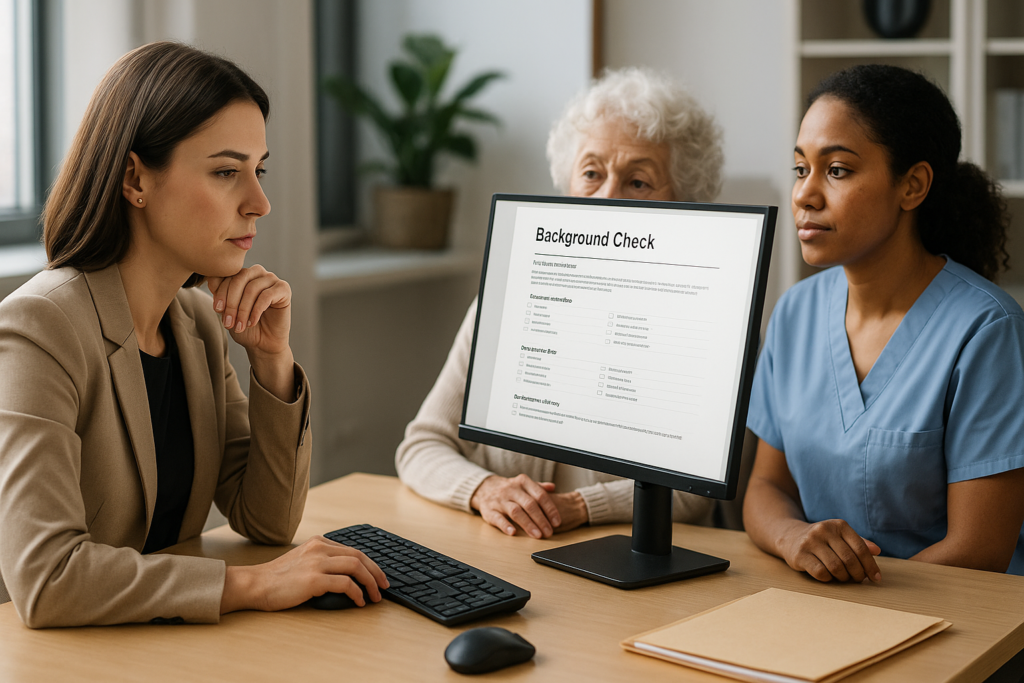
Screening Caregivers and Home Health Aides: Protecting the Most Vulnerable Clients
Estimated reading time: 6 min
Key takeaways
- Use a role-based, risk-focused screening package that includes identity verification, criminal and exclusion checks, license verification, and continuous monitoring.
- Follow FCRA and state rules: perform most checks after a conditional offer, obtain written consent, and use documented adverse-action procedures.
- Adjudicate consistently and fairly — assess relevance, time elapsed, and rehabilitation rather than applying blanket exclusions.
- Balance speed and safety operationally with prioritized checks, ATS integration, provisional supervision, and automated monitoring.
Why screening caregivers and home health aides matters
When you hire caregivers and home health aides, you’re not just adding staff — you’re placing people into private homes and trusting them with clients who may be elderly, medically fragile, or cognitively impaired. A thorough, consistent background screening program is the single most effective way to reduce safety, regulatory, and reputational risks associated with those roles. This guide lays out practical, legally aware screening practices and operational tips that HR leaders, recruiters, and hiring managers can implement to protect clients and the organization.
Care settings differ from conventional workplaces: care is delivered in personal spaces, often unsupervised, and frequently by staff who transport clients or handle medications and finances. That combination elevates several risks:
- Direct client harm: physical abuse, neglect, theft, medication errors.
- Liability and regulatory exposure: employing excluded persons can jeopardize Medicare/Medicaid billing and trigger sanctions.
- Reputational damage: a single incident can destroy community trust and referral networks.
- Operational disruption: incidents create turnover, investigations, and compliance headaches.
Robust screening reduces these risks while helping ensure you hire people whose backgrounds and credentials match the trust clients expect.
Core components of screening caregivers and home health aides
A comprehensive screening package for caregivers and home health aides should be risk-based and role-specific. At a minimum, consider the following checks:
- Identity verification and multi-factor name search
Confirm legal name, aliases, and DOB; use fingerprinting for greater identity accuracy where appropriate.
- Criminal background checks
Nationwide multi-jurisdictional searches plus county-level records in relevant locations; include international checks if the candidate lived abroad.
- Sex offender registry checks
National and state registries; cross-check aliases and prior addresses.
- OIG/GSA exclusion and federal sanctions screenings
Required if staff will work on Medicare/Medicaid-funded cases; also search state Medicaid exclusion lists.
- State nurse aide/abuse registries and healthcare exclusion lists
Many states maintain registries for substantiated abuse, neglect, or professional discipline.
- Professional license and certification verification
Confirm active status for licensed practical nurses or other credentialed staff; verify CPR, medication administration, and specialty training.
- Employment and education verification
Confirm experience and dates of employment; look for unexplained gaps or inconsistencies.
- Reference checks focused on caregiving tasks
Ask about reliability, client interaction, medication handling, and incident history.
- Motor vehicle records (MVR)
Required for employees who transport clients; review for DUIs, suspensions, and high-accident history.
- Drug and alcohol testing
Consider pre-employment and reasonable-cause testing, aligned to state law and company policy.
- Health and immunization verification
TB screening and vaccination requirements where applicable; document compliance with OSHA or facility policies.
- Continuous monitoring
Ongoing checks for exclusions, criminal events, and license status during employment.
Tailor the scope: a live-in caregiver may require deeper identity and residence history checks; aides transporting clients need stringent MVR reviews.
Designing a compliant, risk-based screening program
A screening program must balance thoroughness with compliance and fairness. Key design principles:
- Define role-based screening matrices
Create standardized packages tied to job duties (e.g., direct care, medication administration, transportation).
- Time checks correctly
Conduct most checks after a conditional offer to comply with FCRA guidance and state restrictions on pre-offer inquiries.
- Follow FCRA and state law requirements
Obtain written consent, provide clear disclosure, and comply with background-check notice and adverse-action procedures. Be aware of state lookback limitations and local ordinances that may restrict criminal-history use.
- Maintain consistent, documented policies
Use the same criteria across similar roles to avoid disparate impact claims.
- Securely manage candidate data
Limit access, encrypt records, and define retention periods that meet legal obligations and forensic needs.
- Use an adjudication policy
Establish objective rules to evaluate offenses’ relevance to job duties (nature of offense, time elapsed, evidence of rehabilitation).
- Implement continuous monitoring for high-risk roles
Monthly or quarterly checks for exclusions and criminal events help catch new risks quickly.
- Coordinate with clinical leadership and legal counsel
Ensure screening thresholds reflect actual job duties and regulatory requirements.
Handling red flags and making fair, defensible decisions
Background checks often reveal complexities — convictions beyond the immediate relevance of duties, sealed records, or identity mismatches. A defensible approach includes:
- Assess relevance to job responsibilities
Prioritize offenses that relate directly to client safety (violent crimes, sexual offenses, fraud, medication-related crimes).
- Consider time since the event and rehabilitation evidence
Stable work history, completion of treatment programs, and positive references can be mitigating factors.
- Allow candidates to explain and dispute records
Provide copies of reports and a clear process and timeline for disputes; this is also an FCRA requirement when adverse action is a possibility.
- Apply an individualized assessment rather than blanket exclusions
Rigid bans on classes of convictions increase legal risk and can deny reasonable pathways to employment.
- Document decisions and keep consistent records
Maintain notes that tie the final decision to your adjudication policy and the facts reviewed.
“Being fair and transparent reduces legal exposure and supports ethical hiring practices while keeping client safety front and center.”
Operational tips to reduce hiring risk without slowing hiring
Speed matters for caregiver staffing, but speed shouldn’t sacrifice safety. Practical steps to accelerate reliable hiring:
- Integrate screening into your ATS and onboarding workflow
Automated triggers, e-consent, and single-sign portals reduce candidate drop-off and administrative lag.
- Prioritize critical checks first
Run identity, criminal, and exclusion checks immediately after a conditional offer; run MVRs and credential verification in parallel.
- Use fingerprinting where identity resolution is critical
Fingerprints reduce false matches and are required for some state registry queries.
- Train hiring managers on red-flag interpretation
Short decision guides help recruiters make consistent early decisions and escalate complex cases.
- Implement provisional supervision plans
For urgent placements, consider supervised, time-limited starts where an employee is shadowed until full checks are complete, consistent with state and federal rules.
- Standardize caregiver references
Use a checklist-style reference script focused on client safety, punctuality, and honesty.
- Automate continuous monitoring for exclusions
This reduces risk without repeated full rechecks and is cost-effective for active caregivers.
Practical takeaways for employers
- Build a role-based screening matrix that aligns checks with actual duties (e.g., medication administration, driving, finance).
- Always screen for federal and state healthcare exclusions when employees may touch Medicare/Medicaid-funded services.
- Use multi-jurisdictional criminal searches plus county records; add fingerprinting to reduce identity errors in high-risk roles.
- Standardize adjudication to evaluate relevance, time elapsed, and evidence of rehabilitation; avoid blanket exclusions.
- Follow FCRA and state notice/adverse-action rules; document every step for defensibility.
- Implement continuous monitoring for exclusions and license status to catch new risks quickly.
- Combine screening with strong onboarding, supervision, and training to reduce both hiring and operational risk.
Conclusion
Screening caregivers and home health aides is a critical risk-control function that directly protects vulnerable clients, preserves compliance, and safeguards your organization’s reputation. A targeted, compliant program—built around identity verification, criminal and exclusion checks, credential validation, and fair adjudication—reduces the likelihood of harm without unduly slowing hiring.
If you need help designing or operationalizing a screening program that balances client safety, regulatory requirements, and hiring velocity, Rapid Hire Solutions can advise on role-based matrices, compliant processes, and continuous monitoring options to fit your operations.
FAQ
-
What checks are absolutely required for aides working on Medicare/Medicaid cases?
Answer: At minimum, screen for OIG/GSA federal exclusions and relevant state Medicaid exclusion lists. Also conduct identity verification, criminal background checks, and license/certification verification if applicable. Document results and follow any state-specific screening mandates.
-
When should I run criminal checks during hiring?
Answer: To comply with FCRA guidance and many state laws, run most criminal and exclusion checks after extending a conditional offer and after obtaining written consent. Some limited pre-offer inquiries may be permitted depending on local rules — consult counsel or HR policy.
-
Are blanket exclusions for convictions recommended?
Answer: No. Blanket exclusions increase legal risk and can be unfair. Use an individualized adjudication policy that assesses relevance to job duties, time elapsed, and evidence of rehabilitation before making hiring decisions.
-
How can we hire quickly without increasing risk?
Answer: Integrate screening with your ATS, prioritize critical checks immediately after a conditional offer, run verifications in parallel, use provisional supervised starts where lawful, and automate continuous monitoring to catch new risks post-hire.
-
Should we use fingerprinting?
Answer: Use fingerprinting when identity resolution is critical or when required by state registries. Fingerprints reduce false matches and improve the accuracy of criminal and registry checks, particularly for live-in caregivers or high-risk roles.