
Security Guard Licensing and Background Checks Guide
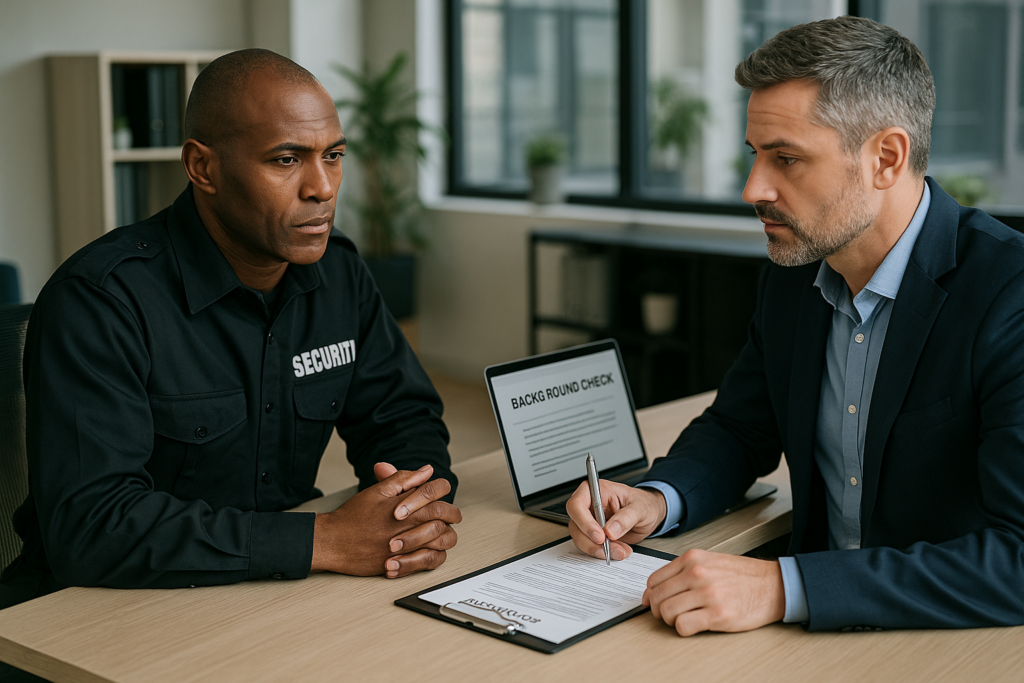
Security Guard Licensing and Background Checks: A State-by-State Overview for Employers
Estimated reading time: 6 minutes
Key takeaways
- State rules vary widely: licensing, fingerprinting, and armed-guard requirements differ by jurisdiction.
- Use fingerprint-based checks where required or when risk warrants—name-only searches are often insufficient.
- Employers carry obligations: verify licenses directly, document individualized assessments, and follow FCRA steps for adverse actions.
- Local ordinances matter: city or county rules can add registration, training, or badge requirements on top of state law.
Table of contents
- How state requirements differ (what to look for)
- State-by-state patterns and representative examples
- Disqualifying offenses, sealed records, and common legal constraints
- Common operational pitfalls and how to avoid them
- Practical checklist for hiring and managing security personnel
- Best practices for reducing hiring risk and staying compliant
- Working with a screening partner—what to expect
- Final thoughts
- FAQ
How state requirements differ (what to look for)
State regulation of security personnel typically varies along these dimensions. When building your hiring and compliance workflows, pay attention to:
- Licensing authority and registration: Some states centralize licensing through a single agency; others delegate to local or county governments. Licensing may be mandatory or limited to certain duties.
- Fingerprint-based criminal checks: Many states require fingerprinting and access to state and FBI criminal history repositories; some accept name-based checks only for certain roles.
- Armed vs. unarmed distinctions: Armed guards usually need an additional permit or endorsement plus firearm training and periodic requalification.
- Initial and ongoing training: Required curriculum, minimum hours, and in-service training rules differ by jurisdiction.
- Disqualifying offenses and look-back periods: States differ on which convictions (felonies, certain misdemeanors, domestic violence, sexual offenses) bar licensure and how they treat sealed or expunged records.
- Reciprocity and portability: Some states recognize licenses from other states or have reciprocal agreements; many don’t—meaning a licensed guard moving states may need to reapply.
- Local ordinances and municipal rules: Cities or counties may layer additional requirements (registration, badges, local training) on top of state rules.
- Employer obligations: Some states hold employers responsible for verifying licenses, maintaining records, and submitting background checks; others place more onus on individual applicants.
State-by-state patterns and representative examples
Listing every statutory nuance for all 50 states would overwhelm this guide. Instead, here are common regulatory patterns and representative states where those patterns are clearly in force. Use this to prioritize deeper, jurisdiction-specific review.
1) States with centralized licensing and fingerprint-based checks
These states typically require a state-issued security license, mandatory fingerprinting, and checks against state and federal criminal databases. Examples include California and New York. Expect robust application processes and routine renewal requirements.
2) States with strong armed-guard controls
Jurisdictions that regulate armed security separately require firearm qualifications, separate permits, and mandated training. Examples include Texas and Florida, where employers must document firearm training and ensure permits are current.
3) States with employer-driven compliance
Some states place a heavier administrative burden on employers to initiate background checks, report adverse events, or track continuing education. Employers should build internal workflows to verify compliance proactively.
4) States with significant municipal variation
In large metropolitan areas, city or county ordinances may add registration, additional training, or badge issuance that is distinct from the state license. Always check local requirements for your job sites.
5) States with limited or less prescriptive frameworks
A subset of states maintains lighter-touch frameworks that rely more on private security companies’ self-regulation or employer vetting. Even where the statute is looser, client contracts and insurance carriers often impose stricter standards.
Disqualifying offenses, sealed records, and common legal constraints
Across most jurisdictions, employers should expect the following trends, though specifics vary:
- Felony convictions commonly disqualify applicants for security roles, particularly violent or sexual offenses.
- Crimes involving dishonesty (fraud, theft) are frequently disqualifying because of trust concerns.
- Domestic violence, assault, and some substance offenses can bar licensure depending on recency and severity.
- States diverge on the treatment of sealed or expunged records—some allow employers to disregard them; others require disclosure in licensing contexts.
- Arrests without conviction are treated differently across states and may be excluded from licensing decisions.
Federal constraints and equal employment considerations: The FCRA and EEOC guidance shape how employers can use background checks. Follow pre-adverse/adverse action steps and perform individualized assessments to reduce disparate-impact risk.
Key federal points:
- The Fair Credit Reporting Act (FCRA) governs consumer background checks and requires pre-adverse and adverse action notices when an employer relies on a consumer report to take an adverse employment action.
- EEOC guidance encourages individualized assessments and cautions against policies that have disparate impact based on criminal history. “Ban-the-box” laws and state/local fair-chance statutes may restrict when and how criminal history can be asked and considered.
Common operational pitfalls and how to avoid them
Avoid costly mistakes by watching for these frequently observed issues:
- Relying on name-only checks when fingerprint-based checks are required. Name-based searches miss aliases and out-of-state records.
- Assuming reciprocity where none exists. A license valid in one state often doesn’t authorize work in another.
- Failing to verify an active license directly with the issuing state agency or to document that verification.
- Ignoring local ordinances or client-specific requirements (e.g., additional training or insurance limits).
- Skipping rechecks. Licenses expire, and criminal histories can change—periodic re-screening reduces ongoing risk.
- Incorrectly handling adverse actions under the FCRA or not documenting individualized assessments under EEOC guidance.
Practical checklist for hiring and managing security personnel
Use this checklist to operationalize state requirements and reduce hiring risks:
- Verify the state-issued security license and any armed-guard endorsements directly with the issuing agency.
- Run fingerprint-based state and FBI checks when required; use live-scan where available.
- Confirm identity via government ID and match fingerprints or other unique identifiers.
- Verify mandatory training completion and firearm qualifications, including dates and instructors.
- Check for disciplinary actions, license suspensions, or revocations.
- Document how you treated sealed/expunged records in your hiring file based on applicable state law.
- Implement a consistent, written policy for criminal-history screening and adverse action that includes FCRA steps and individualized assessments.
- Monitor licenses and credentials with automated reminders and periodic re-screening (annually or per risk level).
- Include role-specific checks: motor vehicle records, drug testing, and professional references where relevant.
- Consult local counsel or a compliance partner whenever you expand to a new state or municipality.
Best practices for reducing hiring risk and staying compliant
- Treat licensing and background checks as an integrated workflow, not a one-off step. Link license verification, training validation, and criminal background results into the same hiring decision process.
- Use fingerprint-based checks whenever state law or risk profile warrants it—these are more defensible and comprehensive than name-only searches.
- Adopt a consistent, documented approach to adverse actions that complies with the FCRA and state fair-chance laws. Keep records that show individualized assessments and business necessity.
- Build a trusted relationship with a screening partner that understands the idiosyncrasies of the states where you operate and can manage live-scan fingerprinting, state criminal repository checks, and license monitoring.
- Define different levels of re-screening based on risk. Armed guards or those with access to controlled facilities should be rechecked more frequently than lower-risk roles.
Working with a screening partner—what to expect
A compliance-focused background screening partner can:
- Provide jurisdiction-specific guidance on licensing requirements and which checks are mandatory.
- Handle live-scan fingerprinting submissions and FBI checks where required.
- Automate license verification and ongoing monitoring for renewals, suspensions, or revocations.
- Deliver compliant FCRA workflows (pre-adverse/adverse notices) and support consistent recordkeeping.
- Keep your processes up to date as state rules and local ordinances change.
Final thoughts: Security Guard Licensing and Background Checks
Security guard hiring mixes safety, trust, and regulatory complexity. State laws vary on licensing, fingerprinting, armed-guard qualifications, disqualifying offenses, and local registration requirements. For employers, diligence means verifying licenses directly, using fingerprint-based checks where required, documenting consistent policies, and rechecking credentials over time. Taking a structured, state-aware approach reduces liability and helps build a reliable security workforce.
If you’d like help translating state rules into an operational screening program—or want support with fingerprinting, license verification, and ongoing monitoring—Rapid Hire Solutions can assist. We specialize in managing the state-specific details so your team can hire confidently and compliantly.
FAQ
Do all states require fingerprint-based criminal checks for security guards?
Answer: No. Requirements vary. Many states require fingerprint-based checks and FBI access, while others may allow name-based checks for limited roles. Where fingerprinting is required, live-scan submissions are often the preferred method.
Can a security license from one state be used to work in another state?
Answer: Usually not. Reciprocity exists in some cases, but many states require separate licensure. Always verify portability before assigning staff to a different jurisdiction.
How should employers handle sealed or expunged records?
Answer: Treatment of sealed/expunged records varies by state. Document how you treated these records in your hiring file and consult local law or counsel to ensure compliance.
What are the essential FCRA steps when taking adverse action?
Answer: The essential steps are: provide a pre-adverse action notice with a copy of the consumer report and a summary of rights, allow the candidate time to respond, and then issue a final adverse action notice if you proceed. Maintain documentation of the process.
When should I consult local counsel or a compliance partner?
Answer: Consult local counsel or a compliance partner whenever you expand into a new state or municipality, when handling complex records (sealed/expunged), or when your operations include armed guards or access to sensitive facilities. A partner can also help manage live-scan fingerprinting, license verification, and ongoing monitoring.