
Standardizing Background Checks for Franchise Owners
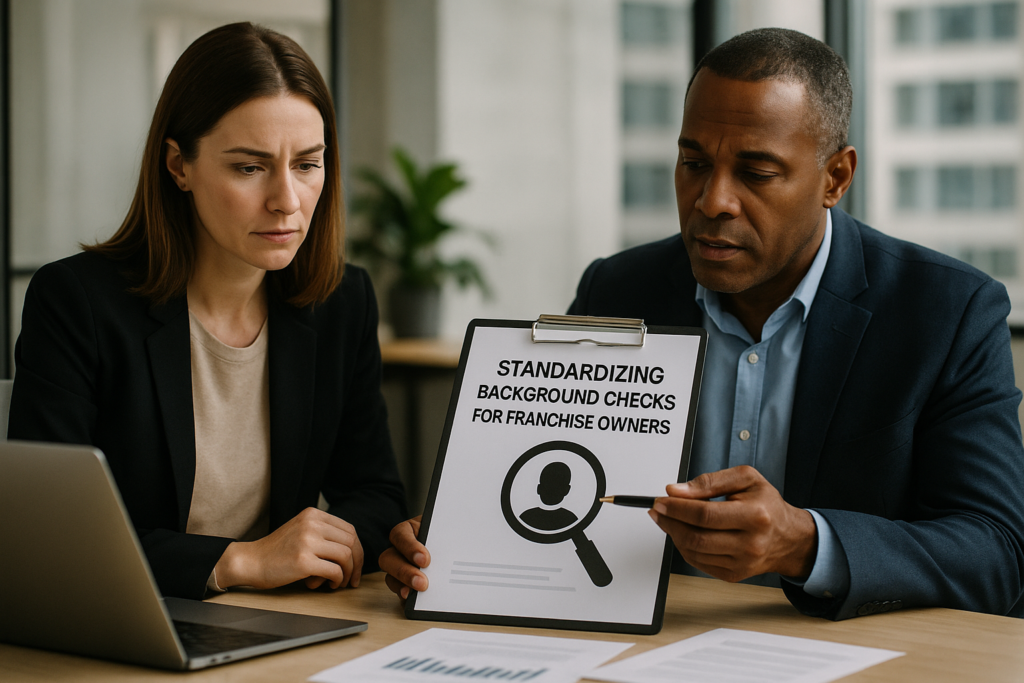
Background Checks for Franchise Owners: Standardizing Screening Across Locations
Estimated reading time: 8 minutes
Key takeaways
- Standardization reduces brand, legal, and operational risk while allowing localized exceptions where the law or business needs require them.
- Build layers: policy, compliance, vendor/technology, training, and governance are all required for a defensible program.
- Adjudication matters: objective scoring, individualized review, and documented adverse-action workflows protect the system.
- Operationalize legal variation with a jurisdictional matrix and automatic ordering logic to ensure compliance at scale.
Table of contents
- Why standardizing background checks matters for franchise systems
- How to standardize background checks for franchise owners
- Balancing uniform standards with state and local legal variation
- Building an effective vendor partnership
- Creating a fair, defensible adjudication process
- Operationalizing across locations: rollout, training, and governance
- Practical legal and privacy considerations
- Cost and ROI: reducing hiring risk and protecting brand
- Quick checklist: Steps to standardize background checks for franchise owners
- Practical takeaways for HR leaders and franchise decision-makers
Why standardizing background checks matters for franchise systems
Managing background checks across a franchise network is one of the clearest ways to protect a brand—and one of the most complicated to get right. A fragmented screening approach creates three core risks:
- Brand risk: a single high-profile incident at one location can damage the reputation of the entire system.
- Legal and compliance risk: inconsistent processes increase exposure to FCRA, state consumer reporting laws, and local fair-chance (ban-the-box) ordinances.
- Operational risk: varying standards slow hiring, create uneven adjudication outcomes, and complicate centralized reporting and oversight.
Standardization doesn’t mean one-size-fits-all. It means creating a uniform framework and decisioning model that can be adapted where the law or legitimate business need requires variation.
How to standardize background checks for franchise owners
A practical standardization program has policy, process, technology, and governance layers. Below are the core components every franchisor should include.
Policy framework
- Clear scope: who is screened (franchise owners, partners, key managers, hourly staff) and at what milestones (franchise approval, periodic re-screening, notable incidents).
- Defined screening package: identity verification, SSN trace, criminal records searches (national and county as needed), OFAC/terrorist watchlist checks, employment/education/license verifications, motor vehicle records for driving roles.
- Adjudication rules: what disqualifies, what triggers individualized review, and how mitigation factors are weighed.
Compliance and consent
- Standardized disclosure and consent forms compliant with the Fair Credit Reporting Act (FCRA) and local laws.
- Mechanisms to honor jurisdictional restrictions such as ban-the-box or limits on how old convictions can be considered.
Vendor and technology standards
- Minimum vendor requirements: FCRA compliance, SOC2 or equivalent security, API integration, and multi-jurisdiction coverage.
- Reporting and audit capabilities for system-wide oversight.
Training and governance
- Rollout plan, manager training, and a central compliance owner responsible for updates and audits.
Continuous monitoring and re-screening
Policies for periodic rescreening and continuous monitoring where appropriate for high-risk roles help detect issues early and reduce remediation time.
“Standardization means creating a uniform framework and decisioning model that can be adapted where the law or legitimate business need requires variation.”
Balancing uniform standards with state and local legal variation
Standardization requires a practical mechanism to incorporate local law differences. Create a legal-variations matrix that maps every jurisdiction where you operate and flags:
- Ban-the-box and conviction-timing rules
- Restrictions on criminal-history questions on applications
- Required forms or disclosures unique to the state
- Record retention limits and consumer rights (e.g., statewide identity theft remedies)
Operationalize this matrix so ordering systems automatically apply the correct disclosure language and scope of search for each location. Work with employment counsel to validate the matrix and review it at least annually.
Building an effective vendor partnership
Choosing the right background-screening partner is one of the biggest levers for consistent results across a franchise network. Evaluate vendors on:
- FCRA expertise and compliance certifications
- Coverage depth (national database + county-by-county court searches)
- Speed and scalability (turnaround time guarantees and batch ordering)
- Integration (API, applicant tracking system compatibility)
- Custom adjudication workflows and reporting dashboards
- Security and privacy standards (SOC2, encryption, breach notification)
- Experience with franchise models or multi-location clients
Sample SLA expectations to include:
- Turnaround time targets per search type
- Accuracy and dispute resolution process
- Monthly audit reports with discrepancy counts and adverse action metrics
- Data retention and deletion policies aligned with your legal matrix
Creating a fair, defensible adjudication process
Consistency in decision-making is where standardization protects you most. A defensible adjudication process should include:
- Objective scoring: assign point values or risk tiers to types of offenses, recency, and relation to the job duties.
- Job-relatedness tests: link disqualifying offenses to specific, documented risks of job performance or workplace safety.
- Individualized assessment: evaluate mitigating factors such as rehabilitation, time since offense, and employment history when applicable.
- Documentation: record the rationale for every adverse decision and the information relied upon.
- Adverse action compliance: follow FCRA steps—pre-adverse notices, reasonable time to respond, and final adverse notices when applicable.
Practical adjudication steps
- Pull the report and compare to the identity baseline.
- Apply the scoring rubric to classify the risk level.
- For potential disqualifiers, trigger an individualized review with standard documentation requests.
- If negative action is considered, follow FCRA pre-adverse and adverse action workflows.
Operationalizing across locations: rollout, training, and governance
A playbook and an implementation timeline accelerate adoption and reduce mistakes:
- Pilot: start with a subset of franchisees or a region to refine processes.
- Training: provide role-based training (franchise sales, HR, hiring managers) and simple job-aid checklists.
- Central oversight: assign a compliance lead at the franchisor level responsible for audits and reporting.
- KPIs: monitor time-to-hire, percent of hires with adverse findings, number of disputes, and average adjudication time.
- Continuous improvement: use monthly reports to identify outlier locations and retrain where needed.
Ordering model decision: decide early whether ordering will be centralized or delegated. Centralized ordering ensures consistency but requires operational support; delegated ordering scales but needs tighter governance.
Practical legal and privacy considerations
Key compliance points to address with counsel and your screening partner:
- FCRA: ensure permissible purpose, proper disclosure and consent, correct handling of consumer disputes, and adverse action compliance.
- Data-sharing: if franchisors and franchisees both need reports, document permissible use and obtain consent that covers sharing. Limit access on a need-to-know basis.
- State/local laws: incorporate the legal-variations matrix into ordering logic and policy.
- Employment classification: confirm whether checks apply to franchise owners, partners, or employees and ensure your policy language reflects those distinctions.
- Record retention: follow the strictest applicable jurisdictional rules for retention and deletion.
Avoid treating legal nuances as minor—missteps in consent language or adverse action can produce litigation and regulatory scrutiny.
Cost and ROI: reducing hiring risk and protecting brand
Screening programs are an investment. Consider the value drivers:
- Fewer negligent-hire claims and lower liability exposure
- Better customer and employee safety, reducing turnover and incidents
- More predictable hiring outcomes and uniform standards that simplify franchisee training
- Faster remediation of problem hires through ongoing monitoring
Frame ROI beyond per-screen cost: measure avoided incidents, faster investigations, and improved customer trust as part of the return.
Quick checklist: Steps to standardize background checks for franchise owners
- Define who must be screened and at what stages (owner approval, annual re-screening, incident-driven).
- Create a standard screening package with clear scope for each role.
- Develop a legal-variations matrix for all operating jurisdictions.
- Draft uniform disclosure, consent, and data-sharing language with counsel.
- Select a vendor that meets FCRA, security, and integration requirements.
- Build an objective adjudication rubric and adverse action workflow.
- Pilot the program, train stakeholders, and iterate.
- Centralize reporting and establish KPIs for ongoing oversight.
- Review the program annually and update for law changes.
Practical takeaways for HR leaders and franchise decision-makers
Key reminders:
- Standardization reduces brand and legal risk but requires a legal-first approach to integrate local variations.
- Your vendor is an extension of your compliance program—pick one that offers strong audit and reporting tools.
- Documented, objective adjudication is your best defense against inconsistent outcomes and legal challenges.
- Training and governance are as important as the technology; inconsistent human decisions often undermine otherwise solid programs.
- Continuous monitoring and a regular review cadence keep the program aligned with evolving laws and business needs.
Standardizing background checks for franchise owners across locations is not a one-time project but an ongoing program that combines policy, technology, and discipline. Get the framework right and you protect your brand, speed hiring, and reduce legal exposure.
If your franchise network needs help designing standardized screening policies, mapping legal variations, or selecting a compliant screening partner, Rapid Hire Solutions can provide program design, vendor evaluation, and operational support to meet your systemwide needs. Contact our team to discuss a tailored approach for your franchise.
FAQ
Can a franchisor require background checks of franchise owners and partners?
Short answer: Yes, but the policy must be lawful, clearly disclosed in franchise agreements and ancillary documents, and implemented consistently. Work with counsel to define scope and permissible uses—especially where owners/partners are not traditional employees.
How should we handle ban-the-box and other local restrictions?
Use a legal-variations matrix incorporated into your ordering logic so the correct disclosure language and search scope are applied automatically. Review the matrix with employment counsel at least annually.
What belongs in vendor SLAs for franchise screening?
Include turnaround targets by search type, accuracy and dispute resolution processes, monthly audit reporting, data retention/deletion policies, security certifications (SOC2), and API/integration requirements.
How do we make adjudication defensible?
Build an objective scoring rubric tied to job-relatedness, require individualized assessments for potential disqualifiers, document the rationale for each adverse decision, and follow FCRA pre-adverse/adverse actions precisely.
Centralized or delegated ordering—which is better?
Both models can work. Centralized ordering maximizes consistency and reporting control; delegated ordering scales but requires stronger governance, training, and system controls to enforce policy.